
 EN
EN
 ar
ar bg
bg hr
hr cs
cs da
da nl
nl fi
fi fr
fr de
de el
el hi
hi it
it ko
ko no
no pl
pl pt
pt ro
ro ru
ru es
es sv
sv tl
tl iw
iw id
id lv
lv lt
lt sr
sr sk
sk sl
sl uk
uk vi
vi et
et hu
hu th
th tr
tr fa
fa ms
ms hy
hy ka
ka ur
ur bn
bn mn
mn ta
ta kk
kk uz
uz ku
ku
NB-IoT DTU
The NB-IoT DTU lists Changsha, China, as the place of origin, Kingmach as the brand, GB50982-2014 as the certification, and a minimum order quantity of one piece. Pricing is negotiable, payment terms are T/T in advance, and delivery time is listed as instant. These business details are useful when the platform is purchased together with sensors, data loggers, acquisition modules, communication devices, or a wider monitoring package. They also show that the software is treated as a formal product category within the Kingmach monitoring range.
Application of NB-IoT DTU
Railway and subway projects use Kingmach NB-IoT DTU to manage distributed sensors along stations, subgrades, tunnels, bridges, slopes, and nearby buildings. Access windows can be limited, so remote data review and alarm records are important. Wired or wireless transmission lets devices send data to the Cloud Platform for storage and visualization. When an alarm appears, related channels and project records help the team decide whether the issue is tied to traffic, construction, water, settlement, or a device condition.
The future of NB-IoT DTU
Cloud computing will support wider remote use of Kingmach NB-IoT DTU. Owners and engineering teams may need to review assets from offices, field sites, control centers, or mobile workstations. Cloud-based access helps keep monitoring visible even when the structure is difficult to reach. Remote review will not replace field verification, but it can improve timing. Teams can identify which area needs inspection, what related data should be checked, and which documents should be prepared before arriving on site.
Care & Maintenance of NB-IoT DTU
Alarm rules in Kingmach NB-IoT DTU should be reviewed by engineering staff, not copied blindly across every point. Different structures, sensors, and risk levels need different alarm logic. A settlement point, strain point, water-level point, and tilt point may require different thresholds, rate checks, and response procedures. After the first operating period, review alarm history and adjust rules where ordinary behavior is creating unnecessary alerts or where a critical pattern needs faster attention.
Kingmach NB-IoT DTU
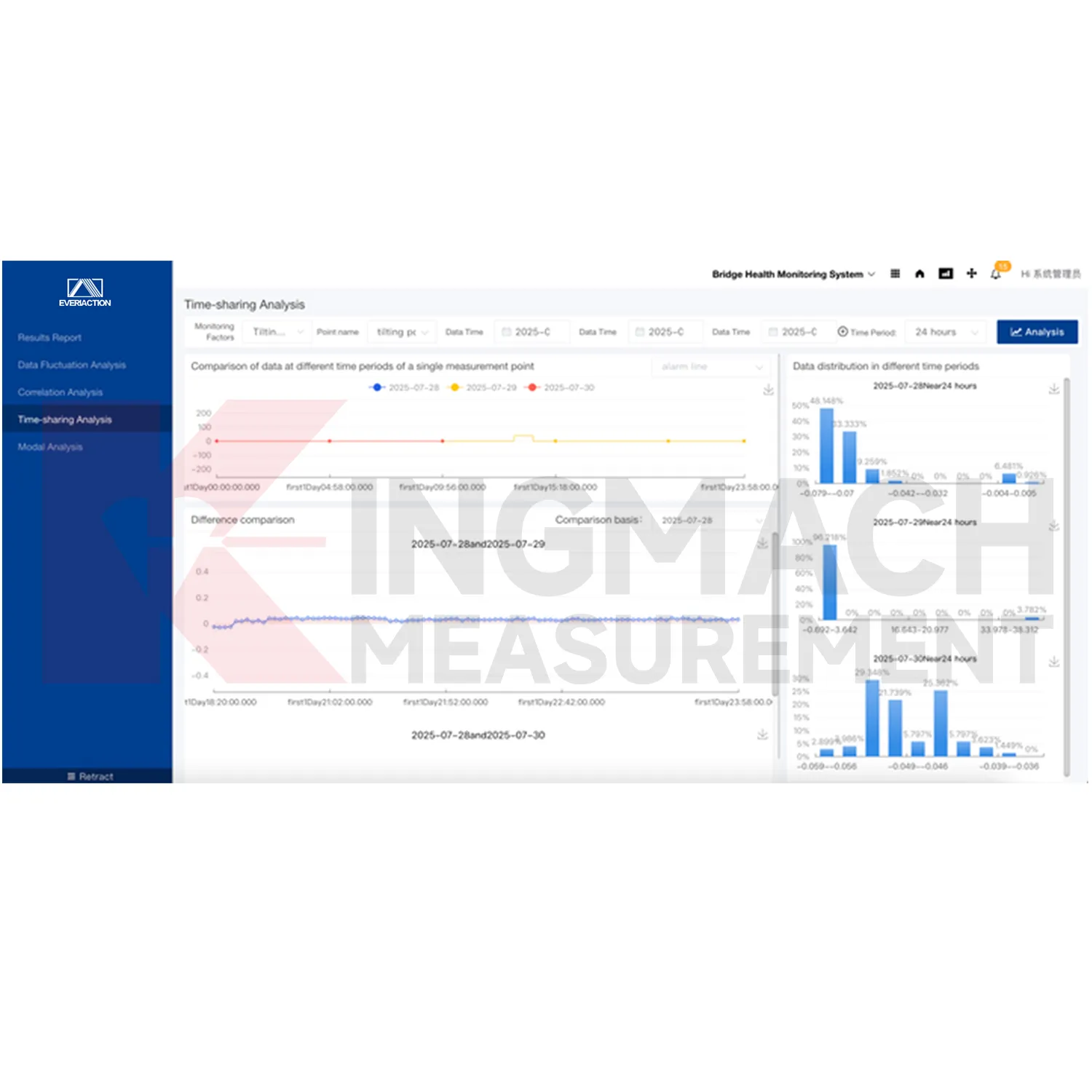
Alarm management is one of the practical strengths of Kingmach NB-IoT DTU. The platform supports flexible alarm rule configuration and can provide detailed fault information in real time when a structure fails or a monitoring value crosses the configured logic. A useful alarm is not just a red mark on a screen; it needs point identity, time, severity, related data, and maintenance reference. By combining alarm rules with project records and monitoring channels, the platform helps teams respond to abnormal behavior with more discipline and less guesswork.
FAQ
Q: How are trend curves used?
A: They help compare current readings with earlier behavior so gradual movement, sudden jumps, or event response can be reviewed.
Q: What does real-time filtering help with?
A: It reduces noisy or distracting records before users study the channel history.
Q: How do alarms guide action?
A: Configured rules point users toward the affected point, severity level, time, and related follow-up record.
Q: What makes reports easier?
A: Stored trends, alarms, project files, and expert review notes can be gathered without rebuilding the evidence manually.
Q: Why is graphical display useful?
A: Graphs help users see movement direction, timing, and abnormal patterns faster than raw tables alone.
Reviews
Ryan Lewis
Fast delivery and excellent product quality. The accelerometers and tiltmeters are highly reliable. Strongly recommend this company.
Joshua Clark
We ordered a full monitoring solution including sensors and data loggers. Everything works seamlessly together. Great supplier!
Latest Inquiries
To protect the privacy of our buyers, only public service email domains like Gmail, Yahoo, and MSN will be displayed. Additionally, only a limited portion of the inquiry content will be shown.
Mia***@gmail.comNetherlands
Dear team, we are interested in your readouts & data loggers compatible with multiple sensors. Do yo...
Isabella***@gmail.comGermany
Hello, we are evaluating weir flow meters for a water management project. Please share accuracy deta...